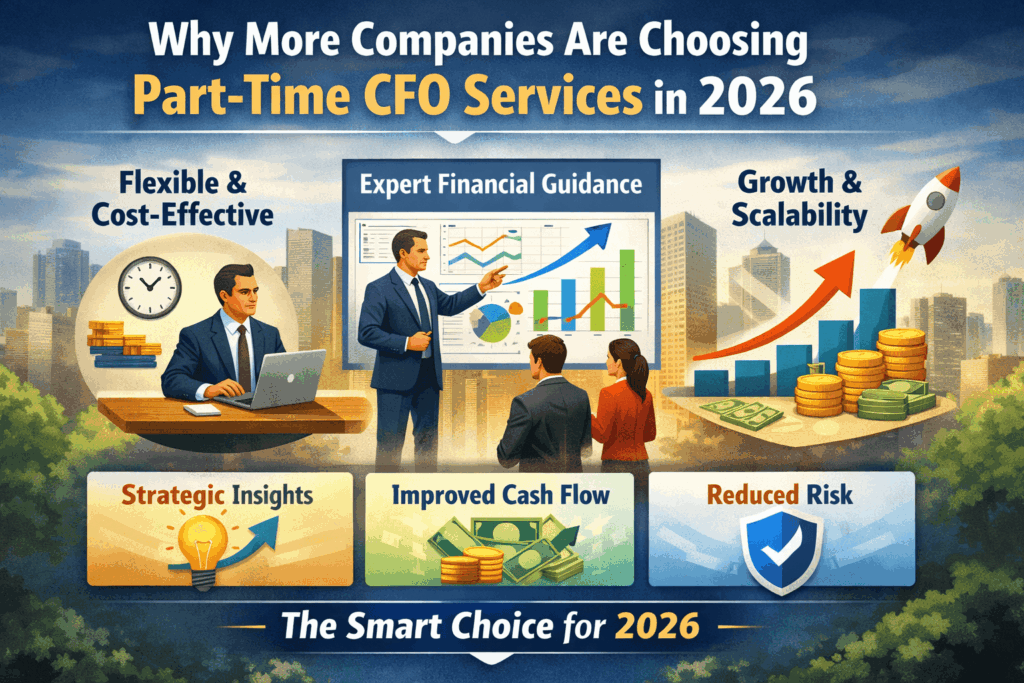
Why More Companies Are Choosing Part-Time CFO Services in 2026
In a world where businesses are navigating a complex financial landscape in 2026, several are considering alternative access to senior financial leadership. The increasing cost of doing business, rapid market changes, and growing compliance requirements have brought more strategic importance in the financial oversight.
At the same time, hiring a full-time Chief Financial Officer is not always feasible and cost-effective, especially when it comes to mid-sized companies. This shift has resulted in growing demand for part time CFO services and fractional CFO services, which are cost-effective and more flexible.
What Are Part-Time and Fractional CFO Services?
Part-time CFO services offer companies access to experienced financial leadership on a reduced, flexible schedule. Instead of hiring a full-time CFO, companies seek the services of an experienced financial expert for a predetermined number of hours or days per month. Fractional CFO have a similar business model in which a CFO works as a part-time member of the leadership team, providing services to multiple organizations at the same time, offering high-level strategic guidance.
Both of these models are designed to provide businesses with the expertise of an experienced CFO, without the long-term financial burden associated with hiring a full-time employee. This method is especially attractive to growing companies, startups, and established companies in the process of transitioning.
Why 2026 Is Driving the Shift Toward Part-Time CFOs
The adoption of part time CFO services has increased at a faster rate in 2026 because of several factors. Uncertainty in the economy, evolving tax regulations, and increasing scrutiny by investors mean that financial decisions must be well-informed and forward-looking. Businesses can no longer rely on basic bookkeeping or reactive accounting practices.
Technology has also transformed how financial leadership is operated. Cloud-based accounting platforms, real-time reporting tools, and advanced forecasting software allow CFOs to provide value effectively without being physically present every day. This makes fractional CFO practical and highly effective.
Strategic Value Beyond Traditional Accounting
One of the biggest myths is that CFOs only manage financial reports and compliance. However, CFOs in modern times play a key role in shaping the business strategy. With part time CFO services, companies gain insights into cash flow optimization, profitability analysis, and long-term financial planning.
A fractional CFO helps leadership teams know what the numbers actually mean for future growth. This includes identifying cost-saving opportunities, improving margins, assessing expansion plans, and making sure that financial decisions align with their business objectives.
Cost Efficiency Without Compromising Expertise
It can be a significant expense to hire a full-time CFO, taking into account costs such as salary, benefits, bonuses, and long-term commitments. For most businesses, this cost outweighs the urgent need. Through Fractional CFO services, senior-level expertise is made available at a fraction of the cost.
This model allows companies to scale financial support as they need. Part time CFO services can be adjusted to match current demands, whether preparing for an audit, raising funds, or going through a period of rapid growth.
Improved Cash Flow and Financial Stability
Cash flow management is one of the most common challenges faced by businesses. A fractional CFO brings structure to the forecasting, working capital management, and financial controls. By closely monitoring the inflows and outflows, businesses get a better understanding of their financial position and reduce the risk of unexpected crises.
This proactive approach helps to have better financial stability and allows leaders to make confident decisions, even during uncertain economic conditions.
Supporting Growth, Funding, and Investor Relations
Credible financial leadership is important for companies that are planning to raise capital or attract investors. Fractional CFO services play an important role in the preparation of financial models, projections, and reporting packages to the expectations of the investors.
Experienced CFOs also help in communication with the lenders and stakeholders, helping businesses to tell their financial story in a professional manner. Such a degree of preparation can help a lot in improving funding outcomes and valuation negotiations.
Integrating CFO Services Into the Leadership Team
A Fractional CFO does not just provide external advice; they usually work closely with owners, CEOs, and internal finance team to empower decision-making and internal processes. This teamwork approach facilitates that financial strategy is incorporated in the day-to-day business.
Companies such as Neil M Financial are a good example of how part time CFO services can enhance the financial leadership with broader business goals, which support both short term and long term sustainability.
FAQs
1. What are part-time CFO services?
Part time CFO services provide businesses with experienced financial leadership on a flexible, part-time basis. They provide them with strategic guidance, forecasting, and financial oversight without the cost of a full-time hire.
2. How are fractional CFO services different from a full-time CFO?
Fractional CFO services provide companies with the same high-level expertise as a full-time CFO but on a shared or flexible schedule. This allows businesses to access senior financial support while controlling costs.
3. Which businesses benefit most from part-time CFO services?
Startups, growing companies, and mid-sized businesses benefit most from part-time CFO services, especially during periods of growth, funding, restructuring, or financial complexity as they don’t have to spend a hefty amount on hiring a full-time CFO.
4. Can a fractional CFO help with cash flow and financial planning?
Yes, fractional CFO services are committed to focus heavily on cash flow management, budgeting, and forecasting. They help businesses improve financial stability and make data-driven strategic decisions.